
The Bronze Casting Process - Lost Wax

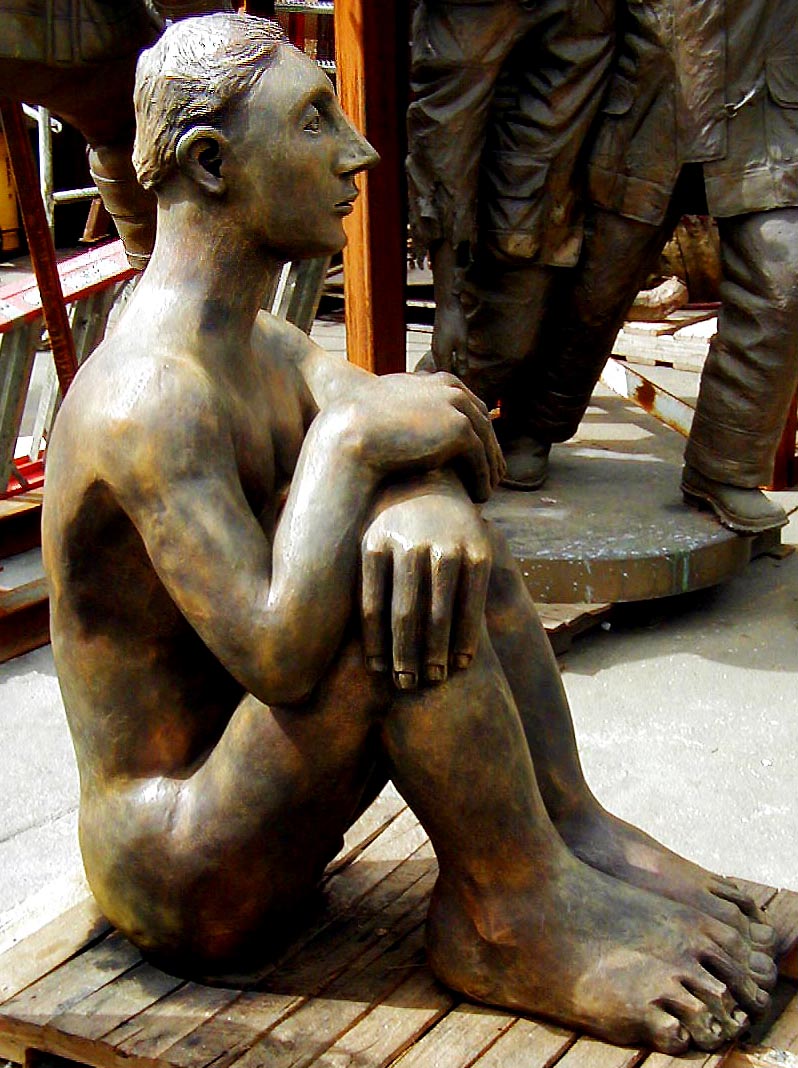

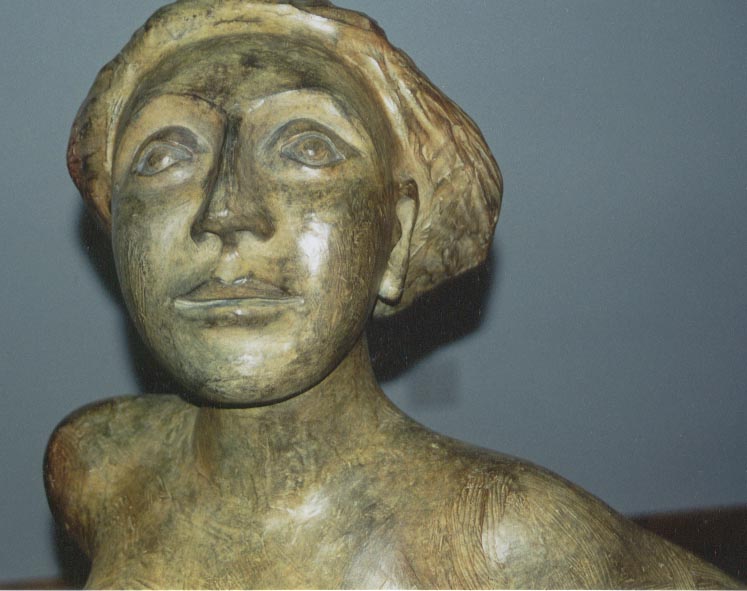
BRONZE SCULPTURE: THE ART OF LOST WAX
In the third millennium B.C., somewhere between the Black Sea and the Persian Gulf, an artist crafted a vision in beeswax, covered it in liquid clay and cooked it in a fire. In the flames the wax was lost, replaced by empty space. Tin and copper - alloys of bronze – were gathered and heated. Once melted, the metal was poured into the cavity of the fire-hardened clay. The metal cooled and the sculptor knocked the clay from the metal. The first bronze was cast.
Ancient "Lost Wax" bronze castings have withstood the centuries, visually telling the tale of past cultures, their religions and their social structures. For example: Chinese bronzes often depicted ceremonial imagery, Indian and Egyptian castings frequently represented deities, the Africans cast images of nature, and the Greeks re-created the human Form. Many of these cultures have grown obsolete, religions have evolved and societies have changed, but an intriguing visual history survives through the surviving bronze works. Certain elements of the "Lost Wax" process have indeed been refined, yet today bronze casting remains essentially the same as it was in 2,000 BC during the Akkadian period.
Modern sculptors who want their pieces cast in bronze depend upon a foundry. There, artisans skillfully apply the "Lost Wax" method to wood, stone, clay, plaster and essentially any other form of sculpture to transform the artist’s vision into bronze.
THE RUBBER MOLD
The metamorphosis of a sculpture from the original medium into bronze begins with a rubber mold. The original sculpture must remain stationary during the mold making process. To accomplish this, half of the sculpture is nestled into a base of soft plasticine clay; the other exposed half is painted evenly with a clear, viscous rubber. (Polyurethane rubber is best for single or small editions while larger editions require silicone rubber.) When the half painted with rubber dries, a protective and rock hard "mother mold" made of reinforced plaster is built around the pliable rubber. The sculpture is then turned over, and the process repeated. When the second side is complete, the mold is opened and the original removed from within. The rubber is rejoined with the other half, rendering an exact "negative" image of the sculpture in rubber. The mold is often done in several sections to facilitate proper and even flow during the actual bronze pour.
THE WAX POSITIVE
The original sculpture is now used exclusively as a reference point. From the "negative" rubber mold, a wax "positive" must be created. Wax is melted to about 210°F, poured into the mold and evenly coated or "slushed" inside. Slushing is repeated three times using cooler wax each time to avoid melting the previous coat. Under ideal conditions, the wax wall will be about 3/16" thick --- any less might create flow problems for the bronze; any more will result in a heavier than necessary sculpture. When the mold is opened and the rubber peeled away, an almost perfect wax reproduction is removed.
WAX CHASING · SPRUING & GATING
"Wax chasing" is the delicate process of joining the wax pieces back together to form a complete “positive” of the sculpture (including removing seams and repairing imperfections with heated customized soldering irons or tools: dental tools being ideal). Artists are very involved at this juncture, checking the integrity of the wax and, after approving it, signing the piece.
After the wax is chased and approved by the artist, the piece is then advanced to "Spruing" or "Gating." This is where channels, through which the molten bronze will travel to the artwork, are added to the wax version. These channels are also made of wax.
"Vents" (thin wax sticks) and "Gates" (thicker wax sticks) are affixed to the wax reproduction with heated tools. Later in the casting process, the space occupied by sprues or gates become runways through which the metal flows and trapped gas escapes. Distribution of the bronze, low turbulence, ventilation and shrinkage are important considerations in the science of gating and spruing.

INVESTING
"Investment" is the process of building a rock-hard shell around the wax sculpture. Later in the process, when the wax has been melted out, the investment will serve as a mold for the molten bronze. For most of history, an investment consisting of plaster, sand and water was used to accomplish this task. In the last 15 years, a new technology called ceramic shell has become the industry standard.
The ceramic shell technique begins by dipping the gated wax into vats of slurry followed immediately by a bath of sand. This process builds a very thin wall of silica around the wax. When repeated approximately 9 times, allowing for drying time in between dips, a hard ceramic shell, about ½" thick, forms around the wax.
Prior to the invention of ceramic shell, solid plaster investment was used. To invest by the solid plaster method: tarpaper was loosely wrapped around the wax reproduction in the shape of a cylinder. The enclosed space surrounding the wax was then filled with a wet plaster/sand mixture. When the plaster hardened, the tarpaper was removed and a solid plaster investment is ready for "de-wax." Whether ceramic shell or plaster is used to make the shell, the wax is a "positive" which must disappear in order to create a cavity or "negative" for the bronze to fill. Thus the phrase "lost wax casting" comes from the process of the wax being melted or "lost" from the shell. Plaster built shells are "de-waxed" in a high-pressure steam chamber known as an autoclave; ceramic invested shells are de-waxed in a kiln.

THE POUR
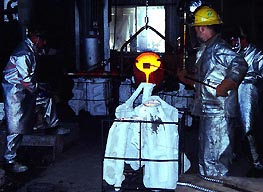
A huge graphite crucible, fired by a furnace, is filled with bronze ingots that are melted. The metal begins to melt at 1700°F. Bronze "seizes" (stops flowing) when confronted with cold, which might occur if molten bronze was poured into a room temperature shell; therefore at the same time the bronze is being blasted by a natural gas furnace, the ceramic shell is heated in a kiln to approximately 1100°F.
When the "Dance of the Pour" begins, the crucible is lifted by crane out of the gas furnace. At the same time, the glowing ceramic shells are brought out of the kiln to the pour area. Two artisans operate the crane that holds the crucible in a "jacket." The artisan with the controls is the "lead pour," the artisan maintaining the crucible balance is known as the "deadman." A third member of the pour team pushes away dross and slag on the surface of the molten bronze.
The entire pour is very fast and very precise; one crucible of bronze holds 400 lbs and can fill one or two large shells or ten or more small shells. The first pieces poured are those with thin walls and intricate details; requiring hot, fluid bronze to move throughout the channel system. The alloy cast at Artworks is known as Silicon Bronze. The metal is made up of the following elements: COPPER 94.0%, MANGANESE 1.1%, SILICON 3.9%, TRACE ELEMENTS 1.0%. Silicon is an additive that helps the "flowability" of the bronze. It achieved widespread use during World War II when lead and tin were in short supply.
DEVESTING
"Devesting" is the process during which the investment is removed from the metal. Approximately one hour after the pour, the piece is cool enough to handle. Skill and strength are combined with hammers and power chisels to knock the investment off the freshly solidified metal. The gates and sprues must also be removed with a high intensity electric arc that can cut through the bronze like butter. The final step is to sandblast the fine investment from the bronze. When clean, the sculpture advances to the metal shop…

METAL CHASING & FINISHING
Like wax chasing, bronze must also be chased or cleaned to address the slight imperfections that may result from the casting or shell building process. On larger sculptures, where assembly of cast sections is required, chasing is essential to take down weld line formed by the joining of two planes. Metal chasing usually starts with large electric or pneumatic grinders to remove the bulk of the unwanted metal. Then, more refined and smaller tools such as die and pencil grinders are used to re-create the artist’s subtle surface texture. Much as a house needs a wood frame to stand, many monumental bronzes require a stainless steel internal structure to support the bronze "skin." Many larger than life-size sculptures are analyzed by a structural engineer who recommends an inner support structure that can reinforce the piece to withstand earthquakes and high winds.

PATINA
Patination is enhancement of bronze by the chemical application of color. Three water soluble compounds form the basis for most patinas: Ferric Nitrate produces reds and browns, Cupric Nitrate creates the greens and blues and Sulphurated Potash produces black.
Each foundry develops its own proprietary (and carefully guarded) patinas that result from a carefully orchestrated blend of different chemicals, pigments and application technique. Wide ranges of colors, both transparent and opaque, are available to the experienced patineur. The final step is putting a thin coat of clear wax over the bronze to enhance and preserve the patina.
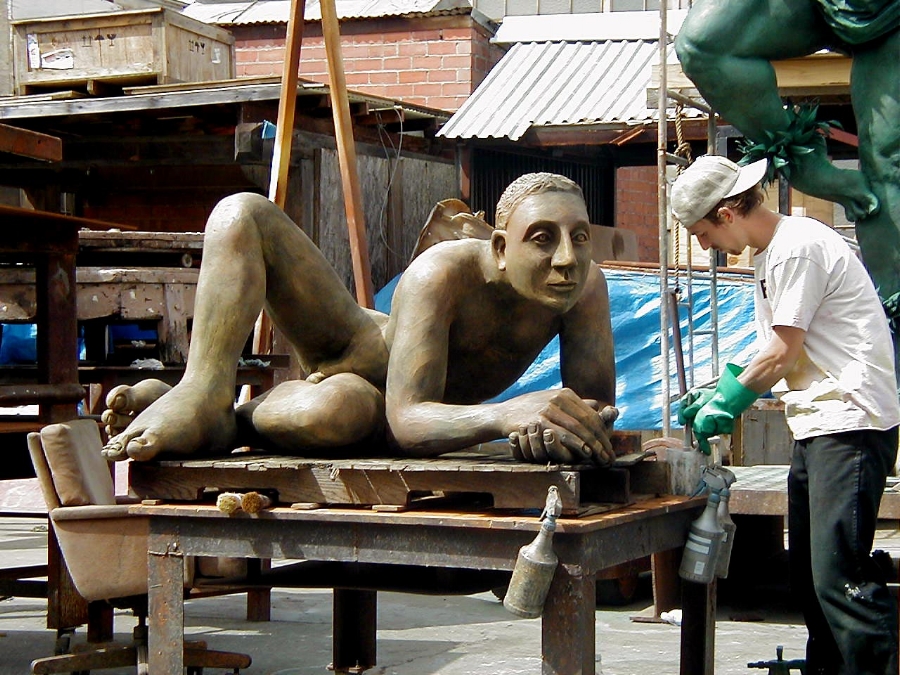
Mavis McClure "Nilo"
We do NOT do bronze casting. Contact your local art foundry or www.artworksfoundry.com
Special thanks to Piero Mussi, Mavis McClure and Artworks Foundry in Berkeley.